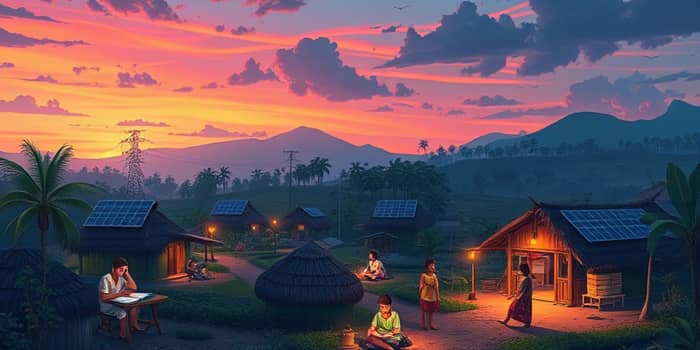
Nearly a billion people remain in the dark, unable to access reliable power, stunting health, education, and economic growth. Across Sub-Saharan Africa and South Asia, dispersed rural communities face unique challenges that make extending national grids costly and slow.
Yet innovative off-grid models are emerging as transformative lifelines. By harnessing solar, storage, and localized networks, these solutions unlock new opportunities for families, entrepreneurs, and entire villages to thrive.
“Off-grid” describes any household or enterprise without connection to a centralized utility network. Traditionally reliant on kerosene lamps, diesel generators, and open fires, these communities now benefit from distributed energy solutions for rural regions that blend affordability with sustainability.
Decentralized power systems can be deployed rapidly, bypassing the logistical hurdles of poles, wires, and bulk infrastructure. They offer a path to universal electricity access by 2030 while reducing dependency on fossil fuels and improving resilience in the face of climate shocks.
The off-grid landscape is diverse, with options to meet every need and budget. Key technologies include:
While solar dominates due to falling panel costs and simplicity, micro-hydro and wind complement hybrids in select geographies.
Off-grid solar products have reached nearly 500 million users worldwide, with standalone units serving over 420 million and mini-grids supporting another 47 million. The global market is valued at roughly $2.8 billion annually, with 30 million units sold in 2021 alone.
Investment flows have surged: between 2012 and 2021, the sector attracted $2.3 billion in debt, equity, and grants, and 2022 commitments topped $746 million—a 63% year-on-year increase. Yet massive gaps persist, underscoring the need for greater capital and innovative financing to scale these solutions as a critical enabler of global energy transition.
Empirical studies reveal how off-grid energy catalyzes development at multiple levels. At the household scale, families experience:
At the community level, mini-grids power agro-processing, cold storage, telecom towers, and irrigation, creating jobs and anchoring local economies.
Despite clear benefits, off-grid deployment faces persistent hurdles. High upfront equipment costs, complex logistics in remote areas, and fragmented regulatory frameworks slow progress. Limited local capacity and nascent supply chains further constrain scale.
Overcoming these challenges requires targeted interventions: blended financing to reduce risk, streamlined licensing, and public-private partnerships that leverage local networks. By overcoming financial and regulatory barriers, stakeholders can unlock durable growth and broaden access.
Sub-Saharan Africa hosts the largest share of the global electrification gap, with over 500 million people off-grid. In rural villages of Kenya and Nigeria, PAYGo solar firms have transformed everyday life, while mini-grids in Tanzania power grain mills and health clinics.
In South Asia, communities in Bangladesh and India harness rooftop solar home systems to drive irrigation and cottage industries. These initiatives are not just powering lights but empowering women and entrepreneurs at scale, enabling micro-enterprises to flourish.
The off-grid revolution stands at an inflection point. Advances in battery chemistry, digital monitoring, and smart financing are converging to make systems cheaper, more reliable, and easier to manage. Coupled with supportive policies and local capacity building, this momentum can close the access gap by 2030.
Investors, governments, and communities must collaborate to channel capital, enact enabling regulations, and foster local entrepreneurship. By scaling proven models and nurturing innovation, we can transform energy poverty into a powerful driver of sustainable development.
Beyond the grid lies a future where no one is left in the dark, and emerging markets thrive on the clean, reliable power that ignites opportunity.
References