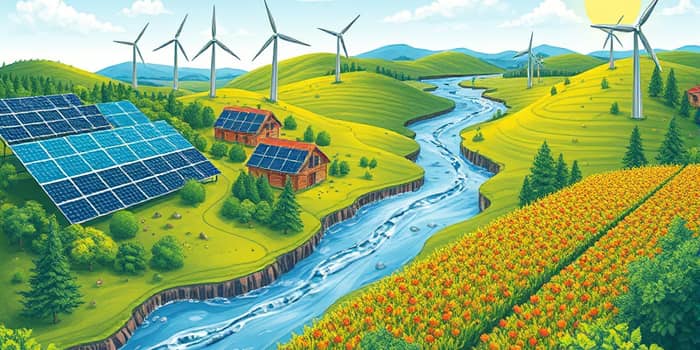
As global populations rise and climate change intensifies, the entwined challenges of water scarcity, energy security, and food supply demand a unified approach. The Water-Energy-Food (WEF) nexus framework transforms isolated infrastructure projects into system investments that deliver multiple benefits. By aligning finance, policy, and technology, investors can unlock resilient, sustainable solutions that serve communities, economies, and ecosystems in harmony.
At the heart of the WEF nexus lies a simple truth: water, energy, and food are mutually dependent. Agriculture draws 72% of all freshwater withdrawals, energy production uses 90% of power generation sites requiring water for cooling, and food systems consume over one-quarter of global energy output. When one sector falters, ripple effects strain the others, threatening livelihoods, environmental health, and economic stability.
This interdependence creates both challenges and opportunities. Investments in water-saving irrigation or renewable energy for pumping can yield avoided costs and ecosystem resilience. Conversely, unchecked demand in one area can deplete resources elsewhere. Effective nexus strategies identify synergies—like waste heat reuse in greenhouses—and manage trade-offs, such as competition for land between solar farms and crops.
By 2050, global food demand will surge by 50%, water withdrawals could rise 20–30%, and energy needs may grow nearly 19%. In baseline scenarios, energy demand could double, and water and food must increase by over 50%. These shifts, driven by population growth and consumption patterns, unfold against the backdrop of more frequent droughts and extreme weather.
Improvements in water-use efficiency climbed 20% from 2015 to 2021, yet 58% of reporting countries remain inefficient. Meanwhile, producing a single person’s daily nutrition can require 2,000–5,000 liters of water. Advanced cooling systems and biofuel expansion could raise water withdrawals for energy by 20% and consumption by 85% by 2035. These statistics underscore the urgency—and the investment opportunity—in integrated solutions.
To translate nexus concepts into bankable projects, investors and policymakers must embrace four core pillars that ensure cross-sector planning and scalable financing:
Even the most promising nexus projects face hurdles. Fragmented governance across ministries fragments decision-making. Siloed budgets fail to capture combined returns. Data gaps impede life-cycle analysis. And long payback periods deter commercial investors who seek immediate cash flows.
Addressing these obstacles requires regulatory coordination and standardized criteria. Ministries must collaborate under unified nexus policies. Investment frameworks should quantify direct revenue, avoided costs, resilience gains, and ecosystem service value. Enhanced data-sharing and transparent benchmarks will enable financiers to compare projects on a like-for-like basis, reducing uncertainty and unlocking capital.
Real-world examples illustrate how integrated financing can transform nexus challenges into opportunities for growth and resilience.
Investing in the WEF nexus demands a paradigm shift: from siloed sector finance to holistic system finance. Public funds should derisk projects, laying the groundwork for private capital. Financial metrics must evolve to capture co-benefits—avoided losses, ecosystem services, and resilience gains—as real value streams.
By aligning policies, standardizing criteria, and harnessing blended finance, stakeholders can build a virtuous cycle of socio-economic and environmental returns. The nexus approach is not merely an investment strategy; it is a blueprint for secure, sustainable prosperity that safeguards resources for current and future generations.
References