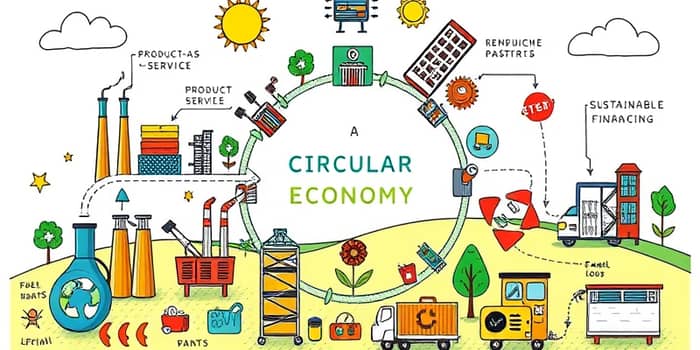
As resource pressures mount and waste volumes soar, the concept of circular capital emerges as a vital force to transform our linear systems into sustainable, regenerative loops. This article examines how strategic finance can unlock a closed-loop economy and offers practical guidance for investors, policymakers, and entrepreneurs.
The traditional “take–make–waste” model consumes finite resources at approximately 1.75 times the planet’s regenerative capacity each year, while only 6.9% of global economic activity is genuinely circular. Cities, as energy and waste hotspots, highlight the urgency: they demand two-thirds of global energy, produce up to 50% of solid waste, and drive 80% of greenhouse gas emissions. Yet the circular economy presents a vast prize—an estimated USD 4.5 trillion in additional growth by 2030 and potential material savings of USD 700 billion for consumer goods.
To seize this opportunity, we must align capital flows with circular strategies that design out waste, keep products and materials in use, and regenerate natural systems. That alignment is what we call “circular capital.”
Circular capital encompasses the full range of public and private finance—debt, equity, blended instruments, and policy-driven support—dedicated to enabling circular business models and infrastructure. These funds target initiatives from recycling and reverse logistics to product-as-a-service schemes and digital material tracking.
Financiers evaluate such projects on a spectrum of risk and return. Many are new or unproven business models that demand concessional or flexible capital, while others offer infrastructure-like cash flows that can attract debt finance once scaled.
Capital directed into circular initiatives typically flows into projects that:
Various financial instruments serve these needs:
Investment in circular economy business models has surged from USD 10 billion in 2018 to USD 28 billion in 2023, peaking at USD 42 billion in 2021. This represents an 87% surge in investment appetite for circular solutions compared to 2018–2020. Yet these flows remain just 2% of all tracked capital, signaling a colossal opportunity for growth.
Geographically, capital is heavily concentrated: North America and Europe account for 84% of disclosed circular investments, while low- and middle-income countries capture just 7%—and Africa only 0.2%.
Despite the rapid proliferation of circular economy roadmaps—24 EU member states have action plans—investment remains skewed toward end-of-pipe waste management. The European Environment Agency estimates the EU needs EUR 170 billion per year for a full circular transition, but current financing levels stand at EUR 141 billion, leaving an investment gap of ~EUR 29 billion per year until 2027.
Policy frameworks such as the EU Circular Economy Action Plan, the sustainable finance taxonomy, and harmonized circular economy finance guidelines are critical to standardizing definitions, reducing investor confusion, and steering capital to system-changing investments.
Innovative funds and institutions are demonstrating what circular capital can achieve. Closed Loop Partners, for example, deploys a multi-stage fund strategy to invest in recycling technologies, supply chain platforms, and product lifecycle services. Impact investors are also turning to sustainability-linked bonds that reward issuers for meeting circularity targets, aligning financial performance with environmental outcomes.
Case studies—from lithium-ion battery reuse projects in Europe to green solvent manufacturing for plastic packaging in Asia—highlight how blended finance, technical assistance, and public-private partnerships can de-risk early-stage ventures and crowd in larger pools of capital.
To scale circular capital, stakeholders must:
Investors should collaborate with policymakers, corporations, and civil society to identify high-impact opportunities and share data on performance. By doing so, they can close funding gaps and direct capital toward initiatives that offer both financial returns and environmental regeneration.
The circular economy is no longer a niche concept—it is an urgent imperative. With trillions in economic value at stake, the time for decisive action is now. Through strategic alignment of capital with circular solutions, we can build resilient economies, restore natural systems, and leave a legacy of stewardship for future generations.
References